Speech and language therapist shares experience of life-changing jaw surgery
Published on 20/11/2026
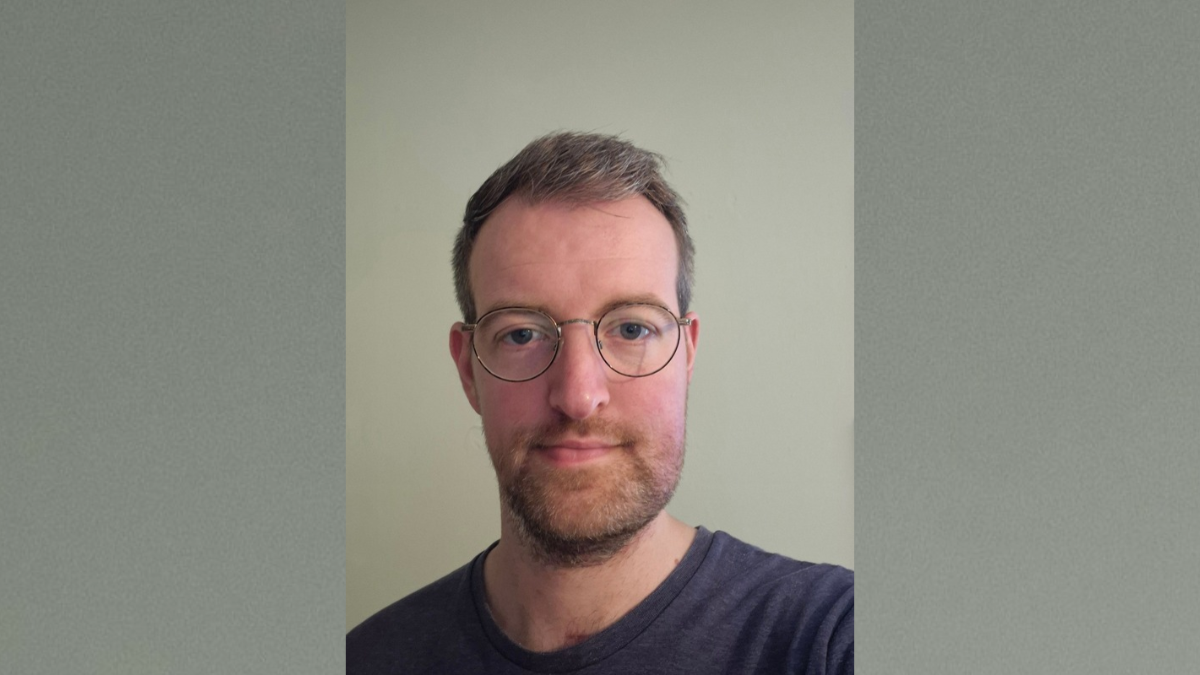
You may recognise 34-year-old Aaron Emmett from the recent episode of Surgeons: A Matter of Life or Death, which followed his journey through major reconstructive jaw surgery at Queen Elizabeth Hospital Birmingham (QEHB).
Aaron, a Speech and Language Therapist and Lecturer in Speech and Language Therapy at Birmingham City University, underwent complex maxillofacial surgery after a benign but recurring tumour affected his jaw. Aaron shares his experience with us:
"I was around 14 years old when they first discovered a tumour in my jaw. It was picked up completely by chance during a routine dental X-ray. I went through a series of investigations to establish what it was, including a biopsy, which thankfully confirmed that it wasn't malignant.
"I then had surgery called enucleation, where they go in through the gum and essentially scrape out as much of the tumour as possible, without removing the surrounding jawbone.
"At that point, we thought that would be the end of it. There had been a passing comment that these things could sometimes recur if they hadn't managed to remove everything, but we were hopeful that the surgery had been successful.
"Then, when I was about 25, another routine dental X-ray showed that the tumour had returned and was growing again. I had another biopsy, followed by another enucleation, but it was around this time that we started having conversations about the likelihood of it continuing to come back.
"It was becoming clear that, unless we did something more drastic, it would just continue to recur.
"After that, I moved to Birmingham and my care was transferred to QEHB, which was when we started discussing the possibility of a partial mandibulectomy.
"That involved removing the affected section of my jawbone, from the middle to the where it joins onto my upper jaw, and reconstructing it using my fibula, which is one of the bones in your lower leg. The surgeons essentially took that bone, shaped it and put it in place of the section of jaw they had removed.
"Obviously, when I first heard what the surgery involved, it was quite stressful and I was apprehensive about it. But for a long time, we'd been hopeful that the less drastic measures would be enough, and eventually it became clear that this was going to have to be the outcome.
"By the time the surgery actually came around, I think there was more relief than anything. I'd been dealing with this tumour, on and off, since I was a teenager, and I just wanted to have the operation, put it to bed and finally have some closure.
"I had the surgery in June, and I'm really pleased with how well everything has gone since then.”
Surgeries like Aaron's can have a significant impact on a patient's ability to speak, eat and swallow with the jaw being vital in helping us to produce and chew food. Removing or reconstructing part of it can affect the movement and coordination needed for these everyday functions.
Following surgery, patients may need support to regain their ability to communicate and swallow safely, with speech and language therapists playing a vital role in assessing and supporting rehabilitation as patients adjust to changes in their mouth and jaw.
"One of the slightly unusual things about my experience is that I'm actually a speech and language therapist myself, so some of the things I went through as a patient were things I'd previously learned about during my training.
"It was a complete coincidence that I ended up in this profession. I originally did an undergraduate degree in psychology and was looking for healthcare-related roles afterwards. I ended up working as a speech and language therapy assistant for a few years, before going back to university to do my master's degree and qualify as a speech and language therapist.
"During our training, we'd had teaching on head and neck cancer, the types of surgery involved, tracheostomies and the rehabilitation people might need afterwards. All things that I ended up experiencing as part of my own surgery.
"But my actual clinical experience was about as far removed from this type of surgery as you could get. I worked in children's community services before becoming a lecturer at Birmingham City University, so it was interesting to see how much of that teaching I remembered.
"I certainly came into it with a better understanding than most people might have of what was going on, and some of the terminology being used, but it was still quite strange to find myself on the other side of those interactions.
"Speech and language therapists were a really important part of the team looking after me while I was in hospital, particularly when it came to getting me speaking and swallowing again.
"I remember Camilla, one of the therapists, asking me something that was really nice to hear as a patient. She said, 'Do you want me to speak to you like a speech and language therapist, or do you want me to speak to you like a patient?'
"And I said, 'No, please speak to me like a therapist. Speak to me like somebody who has a bit of an idea of what's going on, and if I don't understand something, I'll tell you.'
"I thought that was a really nice way of approaching it, and it was interesting to experience that interaction from the patient's perspective.
"One of the things I was particularly pleased about was how quickly I was able to speak after the operation. Only a couple of days after surgery, the team were able to deflate the cuff on my tracheostomy, which meant that more air could pass through my upper airway and I was able to speak while covering the tracheostomy opening.
"So, within about three or four days of having the surgery, I was already able to talk, which was relatively quick considering the extent of the operation.
"Of course, while this type of surgery is often carried out for people with head and neck cancers, my circumstances were a little different.
My tumour was benign and slow-growing, so the surgery was more conservative than it might be for somebody who also needed radiotherapy or other interventions, which can have a lasting impact on both speech and swallowing.
"I'm now just over four months on from the operation, and I'm really pleased with how quickly everything has recovered.
"Another interesting part of the experience was having the surgery filmed for Surgeons: A Matter of Life or Death. I was quite excited about the opportunity to see some of what happened during the operation, because obviously I was unconscious for the entire thing. I also thought it would be a really valuable opportunity from a professional point of view, to have something I could share with my students and draw some learning from.
"If you're going to go through something like this, then there may as well be some kind of tangible benefit at the end of it.
"There's really no replacement for hearing directly from somebody who has experienced something themselves, so it felt like a good opportunity to contribute to that and share a perspective that my students might not otherwise get.
"The care has been really good, and it's been fascinating to learn more about some of the things that my colleagues might recommend to their own patients.
"It's certainly given me a different perspective on what it's like to be on the receiving end of care, and I'm looking forward to being able to take some of that experience back into my teaching."