Innovative device for cleaning medical equipment rolled out
Published on 25/09/2025
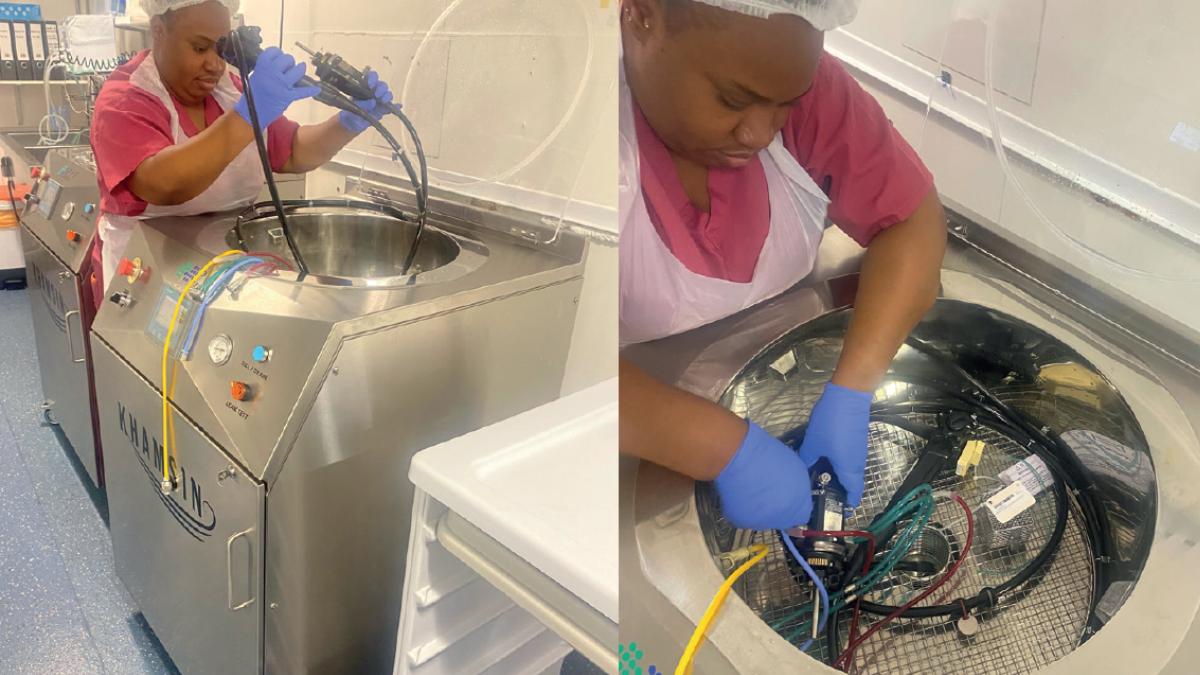
An innovative new cleaning device for medical equipment is to be used across University Hospitals Birmingham (UHB) in a move which could save money, boost efficiency and reduce waste.
The Khamsin endoscope cleaning device was developed between Aston University and Stoke-on-Trent-based PFE Medical.
It could save UHB more than £100,000 a year and boost sustainability, through better efficiency and less waste.
While the device is being used in a number of individual hospitals in the UK, it is the first time an entire NHS trust has adopted the product.
Following successful clinical trials, the Khamsin was introduced in Good Hope Hospital and in 18 months has proved its worth, so will now also be used in Heartlands Hospital, Queen Elizabeth Hospital Birmingham and Solihull Hospital.
Endoscopes are long, thin instruments with a light and camera at one end that are used to look inside the body and require thorough cleaning and high-level disinfection between patients.
They cannot be sterilised in the same way as other medical instruments and must undergo a lengthy manual process, which can take up to seven hours.
The Khamsin can clean an endoscope 1,000 times more efficiently than the manual process in just five minutes. This reduces the risk of contamination to patients and also reduces plastic waste significantly.
Another major advantage of switching to the Khamsin is the cost saving. PFE Medical estimates that the Khamsin saves £1 per clean.
With around 140,000 endoscopies taking place across UHB annually, this results in significant cost savings.
Sharon Fox, head of decontamination at University Hospitals Birmingham NHS Trust, said:
“When I was first introduced to the technology, I immediately recognised that it was something the industry urgently needed. Endoscopy decontamination is still far behind sterile services decontamination, and at UHB we pride ourselves on delivering a gold-standard service in the decontamination of flexible devices for all our patients. We are constantly reviewing new innovations to maintain this high standard.
“At UHB’s decontamination units, we reprocess around 140,000 scopes per year. Our team is highly qualified, as they must understand both the anatomy of the scope and the decontamination process to ensure patient safety.
“Introducing technology that reduces the intensity of manual processing while increasing its effectiveness not only enhances service quality but also supports staff wellbeing and contributes to our sustainability goals.”
Rob Hartley, director of PFE Medical, said: “When ourselves and Aston University first started this project many years ago, I genuinely didn't believe we could achieve the success that we have.
“I am so happy that a Birmingham invention is first being taken up by the Birmingham trust. It will improve the lives of those people whose job it is to make sure every patient has a disinfected, safe endoscope and there are very obvious benefits to patients.”