New clinical investigation explores more inclusive blood oxygen monitoring
Published on 28/09/2026

A clinical investigation at University Hospitals Birmingham (UHB) is exploring whether innovative ear-based technology could help improve the accuracy of blood oxygen measurements across different skin tones.
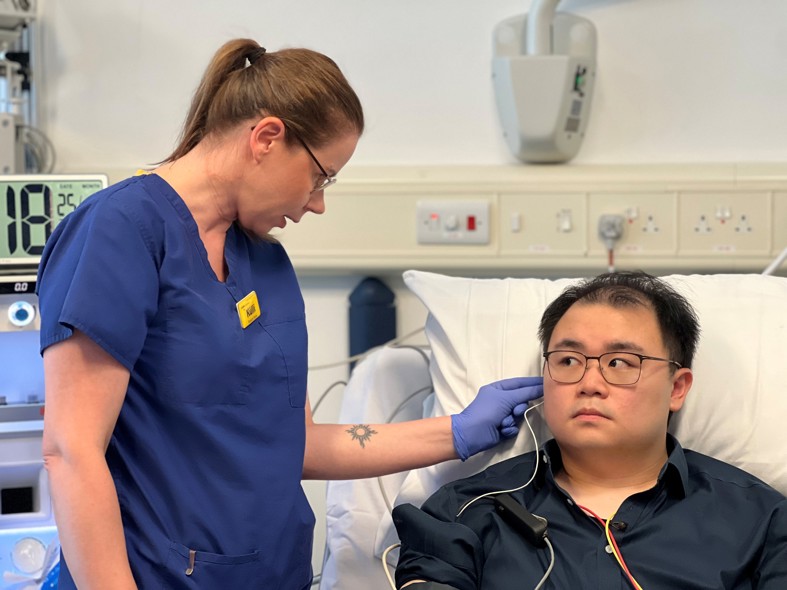
The study, being conducted in partnership with the medical technology company EarSwitch Ltd, is testing the EarMetrics®-Oximeter, a new device designed to measure oxygen levels from inside the ear canal.
Pulse oximeters are routinely used to monitor blood oxygen levels without the need for a blood test. They work by shining red and infrared light through the fingertip to measure blood flow, but differences in skin pigmentation can affect how the light is transmitted and received, which can lead to variations in accuracy.
Previous research has found that some devices can overestimate oxygen levels in people with darker skin tones, potentially meaning low oxygen levels could be missed.
Professor Dhruv Parekh, Principal Investigator of the study and Medical Director for Research and Innovation at UHB, said: “We’ve known for some time that the monitors we use to measure oxygen can sometimes be inaccurate in people with darker pigmentation. These devices are safe because they are not used on their own - readings are considered alongside other clinical measures and observations. However, the aim of this investigation is to find a device that can improve accuracy in measurements for everyone.”
The EarMetrics®-Oximeter takes a different approach by measuring from inside the ear canal, where the skin is not pigmented after the first few millimetres. It uses light to measure changes in blood flow in the inner ear canal to estimate oxygen levels in the blood.
EarSwitch Ltd’s CEO, Nick Gompertz, said: “During COVID-19, it became very clear that pulse oximeters were not working adequately for people with brown and black skin. It showed there was a real clinical need for a more consistent way of monitoring blood oxygen levels.
“Current pulse oximeters measure through the finger, which is some distance from the core blood supply and can be affected by movement, coldness and blood vessels constricting when you are unwell. They also shine light through tissue that can be pigmented, whereas in the ear it measures from an area that is the same colour for everyone, whatever your skin colour.
“We believe this new device could provide more consistent and equitable results for everyone, and we hope it will become a new standard of care for monitoring oxygen - not just here, but across the globe.”
The clinical investigation is funded principally by the charity Asthma and Lung UK, with support from the West Midlands Health Tech Innovation Accelerator. It is being led by the National Institute for Health and Care Research (NIHR) HealthTech Research Centre in Devices, Digital and Robotics (HRC-DDR) and the Medical Devices Testing and Evaluation Centre (MD-TEC), both based at UHB. These teams work with clinicians, academics, health technology companies and patients to test and evaluate new healthcare technologies.
The EarMetrics®-Oximeter is currently pre-regulatory and remains at an early stage of development. Healthy adult volunteers with a diverse range of skin tones are being recruited to take part in the investigation.
Participants are seen at the NIHR Clinical Research Facility Birmingham at Queen Elizabeth Hospital Birmingham. During the study, their oxygen levels are carefully reduced by breathing special gases under very carefully controlled conditions. Researchers then take measurements using the ear-based device and compare its readings with blood oxygen levels obtained from blood samples.
So far, 29 participants have taken part, including Carlos Lee, who said: “The study interested me because I think it’s a very meaningful piece of research looking at how we can get better oxygen measurements for people with different skin tones. As an Asian person, I felt that I could contribute by helping to ensure a more diverse range of skin tones is represented.”
Professor Tom Clutton-Brock, Clinical Director of MD-TEC and the NIHR HRC-DDR, said: “We’ve been really lucky that we’ve been able to recruit volunteers across a range of different skin tones, which is an important part of understanding whether the technology can provide accurate and reliable measurements for everyone. We’d also like to thank PROBr for helping us reach and connect with people from Black and Brown communities and encouraging them to take part in the research.”
The results will help determine whether the EarMetrics®-Oximeter can progress to the next stage of development, bringing the technology closer to potential use in clinical practice.
Learn more about the NIHR HRC-DDR on their website.
This article is part of our research news collection.
Visit our dedicated research site for more research and innovation news from UHB.