New surgical robot benefits patients
Published on 22/12/2025
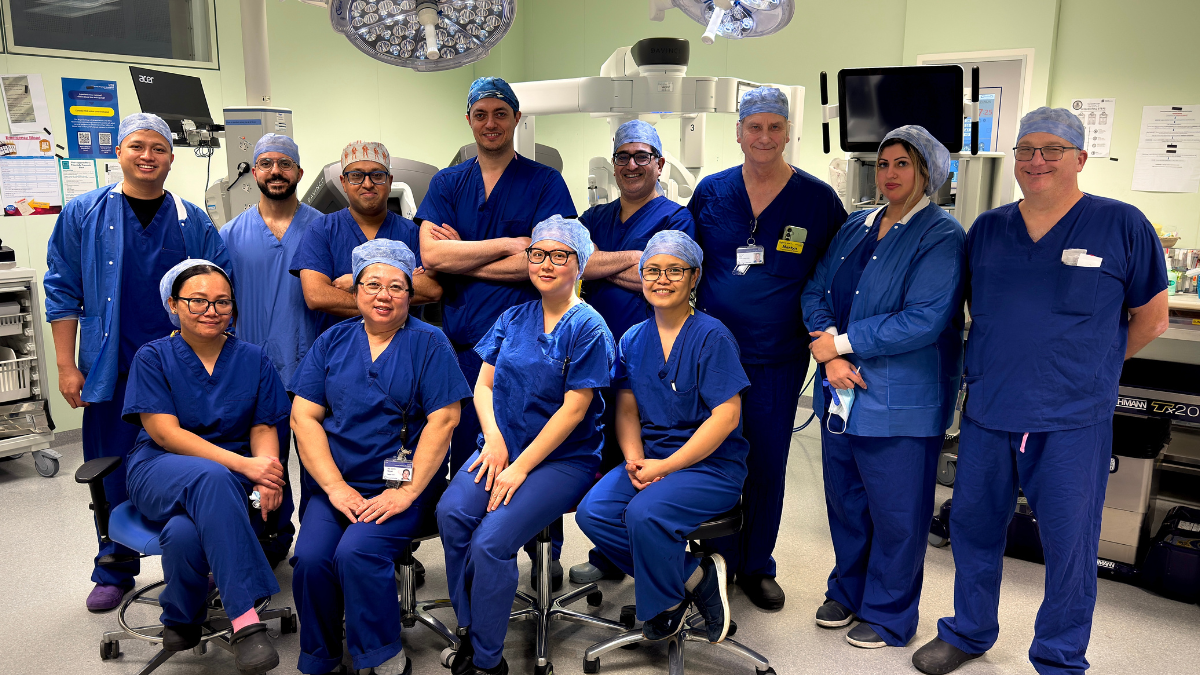
Surgical and theatre teams at Queen Elizabeth Hospital Birmingham (QEHB have successfully integrated a new robot in theatres, allowing more life-saving kidney surgery to take place.
Surgeons successfully performed a partial nephrectomy, where part of the kidney is removed, using the new robot on 18-year-old Elijah Whinfield in December. The robotic procedure is a first-of-its-kind for the hospital.
Elijah’s procedure, which removed a small, rare tumour called a reninoma, will significantly improve his quality of life. Doctors believe the tumour was impacting Elijah’s metabolism and blood pressure and would pose significant long-term risks if left untreated. Surgeons
Hosam Serag, Consultant Urological Surgeon, pictured below, centre, with the other surgeons who carried out Elliot’s partial nephrectomy, said: “On behalf of my surgical colleagues, I want to say a huge thank you to the whole team involved in getting us to the point of being able to operate with the robot here at Queen Elizabeth Hospital Birmingham.
“ So much hard work has gone on behind the scenes to make this surgery possible. In Elijah’s case, we needed to ensure his kidney was temporarily isolated by clamping the arteries and veins to the organ to reduce the risk of renin, an enzyme that controls blood pressure and levels of sodium and potassium in the body, being released.
“Being able to carry out this procedure robotically is less invasive and means Elijah, and future patients needing these kinds of procedures, won’t have large scars, which can lead to chronic pain and bulging, afterwards.”

Elijah, who is now recovering at home, added: “I’m so grateful I was able to have this surgery and that I was home in time for Christmas. I’ll recover quicker than I might have had a robotic partial nephrectomy not been an option, which is obviously a real positive for me.
“I received brilliant care throughout the whole hospital stay and I’m very grateful to the surgeons, doctors and nurses that have been looking after me.”
Surgeons will also be able to use the equipment to carry out full nephrectomies, where the entire kidney is removed.