Published on 29/11/2026
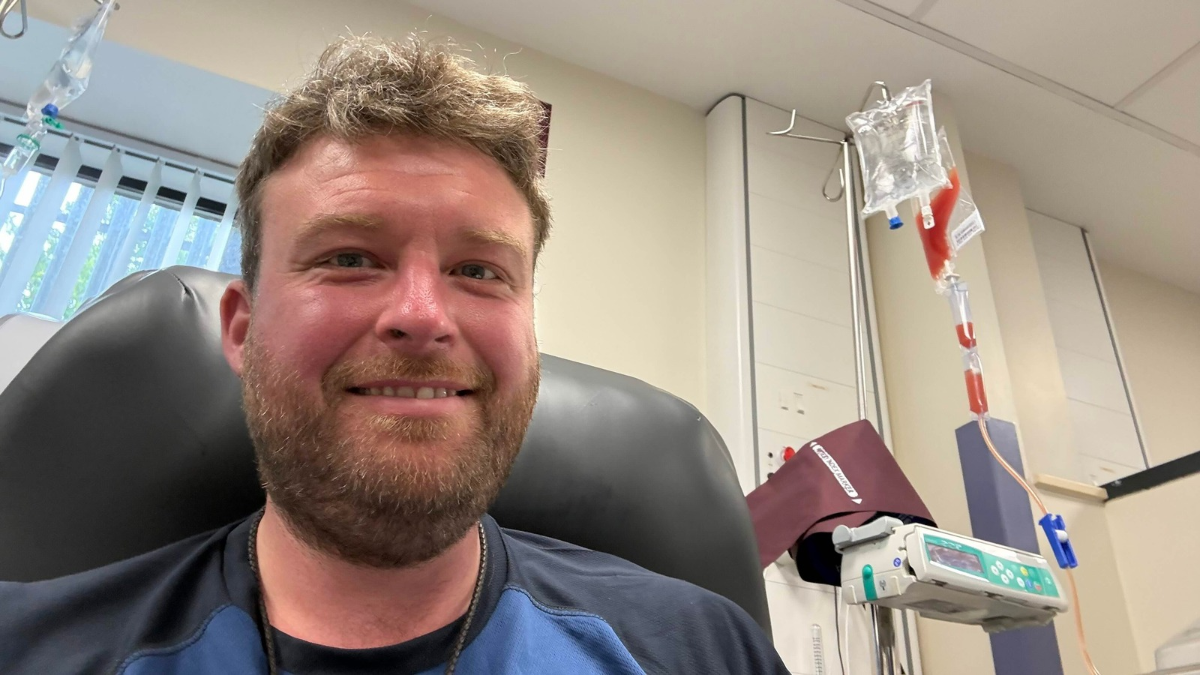
A Birmingham man whose life changed dramatically after developing a rare illness is urging greater awareness of the condition, saying earlier diagnosis could save lives.
Bobby Bridgeman, 43, was diagnosed with POEMS syndrome, a rare disorder affecting around one in a million people.
POEMS stands for polyneuropathy (nerve damage), organomegaly (enlarged organs), endocrinopathy (hormonal issues), monoclonal protein (abnormal blood proteins) and skin changes. It is estimated that just over 170 people have been diagnosed with the condition in the UK in the past 20 years.
The condition, caused by the body making abnormal plasma cells, attacks multiple systems in the body and can often present as severe nerve damage. Without timely treatment, it can quickly become life threatening.
Bobby’s symptoms first began while playing football in January 2025 and what he thought was merely a tight calf quickly progressed into an inability to run.
Over the following months, Bobby consulted physiotherapists, osteopaths, GPs, emergency doctors and specialists, but his condition continued to deteriorate.
By July, he required a crutch to stand, had lost movement in his toes and was experiencing numbness, swelling and poor balance.
Bobby said: “I went for a clinic appointment at Queen Elizabeth Hospital Birmingham (QEHB), and I packed a bag before I left home. I said to my wife ‘I need to be admitted today. I don't care what they say, this can't go on’. I was falling over at home, it was starting to affect my hands, and I knew we had to find out what this is.
“Thankfully, that day, I did get admitted and the care has been absolutely phenomenal ever since.”
At QEHB, Consultant Neurologist Dr Venkataramanan Srinivasan recognised the possibility of POEMS syndrome and ordered a specialist blood test that is rarely requested outside specialist centres.
The result was positive, and Bobby was referred to Professor Michael Lunn, Consultant Neurologist and Clinical Lead in Neuroimmunology, at the National Hospital for Neurology and Neurosurgery at University College London Hospitals (UCLH) for diagnosis, which is home to one of Europe's leading specialist POEMS clinics. By this point, however, his condition had rapidly worsened.
Bobby said: "The progression was so fast. By the time I started chemotherapy, I needed two crutches to get out of a chair, and I couldn't even tear paper.
“Many people I have spoken to with POEMS said the nerve damage left them bedbound and not able to feed themselves before being diagnosed. I feel fortunate that, although severe, the damage was mainly in my lower legs.
“It felt like a long process to be diagnosed, but compared to others, it was detected comparatively early thanks to Dr Srinivasan recognising the possibility of POEMS and the swift collaboration between the teams at QEHB and UCLH.”
Bobby began chemotherapy at QEHB in October 2025 before going on to have a stem cell transplant in June 2026.
In a bizarre twist of fate, Bobby received his chemotherapy at the Centre for Clinical Haematology (CCH) at QEHB, a building he knew incredibly well from his time working for Birmingham-based blood cancer charity, Cure Leukaemia. In 2018, the charity helped raise the funds required to turn the downstairs of the CCH into a day unit allowing patients to receive treatment as an outpatient.
Bobby said: “It has been a surreal experience receiving treatment in a building I know so well but also reassuring as I know so many people that work there. I remember the CCH when it was a building site in 2017. Now I have experience from a patient’s perspective.”
Doctors hope the transplant has eradicated the disease, although it could take several years for his nerves to recover.
Bobby said: "It's been a crazy 18 months. The hardest part wasn't the chemotherapy. It was the sudden disability. That was never on my radar. My family went from seeing me walk normally to crawling upstairs. That's incredibly difficult to come to terms with."
Now recovering, Bobby has turned his attention to raising awareness and funding research into the condition. He has partnered with Inflammatory Neuropathies UK to establish ring-fenced fundraising for POEMS research after discovering there was virtually no dedicated charity support for the condition anywhere in the world.
“I feel I need to do as much as I possibly can to raise awareness and funding for research into the condition. We have started a fundraising campaign and we are trying to create more information and awareness of POEMS online as there was barely anything when I was diagnosed.
"If more GPs and neurologists recognised the warning signs and knew about the simple blood test, people could be diagnosed sooner, avoid permanent disability and potentially save the NHS a lot of money.” he said.
Despite the condition's rarity, he fears many people may never receive the correct diagnosis.
Dr Venkataramanan Srinivasan said: "POEMS syndrome is an extremely rare and complex condition, and diagnosing it can be challenging because its symptoms often develop gradually and affect multiple parts of the body. Bobby’s case highlights the importance of listening carefully to patients, particularly when their symptoms do not fit a more common diagnosis.
"For patients with rare and complex conditions, reaching the right diagnosis promptly can be crucial. Early diagnosis and intervention can help limit long-term disability, support recovery and improve outcomes.
"We are delighted to see the progress Bobby is making. We hope his story will encourage greater awareness of the warning signs and, ultimately, help other patients receive the right diagnosis and treatment sooner."
Prof Michael Lunn said: “POEMS is a fascinating but very unusual disease, and it causes very rapid disability often with a long prodrome before the nerve damage kicks in. Whilst there are many useful clues to the diagnosis they occur across the whole spectrum of medical specialties - blood, nerves, hormones, heart and lung and sometimes brain involvement.
“One of our aims at the UCLH POEMS service is to educate clinicians as widely as possible to think of this rare diagnosis and to provide rapid access to easy and cheap diagnostics that can facilitate diagnosis and treatment at a stage before disabilities become more difficult to reverse.
“One of our other aims is to work with our patients to better understand how the body goes wrong to cause such an unusual and rare disease and that is the aim of our ongoing and unique research programme"
Bobby added: "Yes, it's rare, but what sticks with me is the team at UCLH suggesting some people may not have been diagnosed in time and passed away as a result. If this fundraising and awareness can help prevent that happening for just one person, it will be worth it.”