Patient turns his battle with rare cancer into inspirational book
Published on 03/12/2025
When Paul Evans walked into hospital in February 2024 with pain beneath his ribcage, he never imagined it would lead to a life-altering diagnosis - and writing a book to help and inspire others.
Paul’s initial diagnosis was appendicitis for which he underwent emergency surgery. But in the weeks that followed, Paul also found out he had a rare and aggressive form of cancer known as High-Grade Appendiceal Mucinous Neoplasm (HAMN), a diagnosis so uncommon it affects just one in a million.
Paul said: “It felt like a grenade had been thrown at me when I was given the news.” At 41 years old, he was considered unusually young for this type of cancer. The news left him in a state of shock. “If my appendix hadn’t burst, I’d never have known about the cancer,” he said. “There were no blood markers. It was pure chance.”
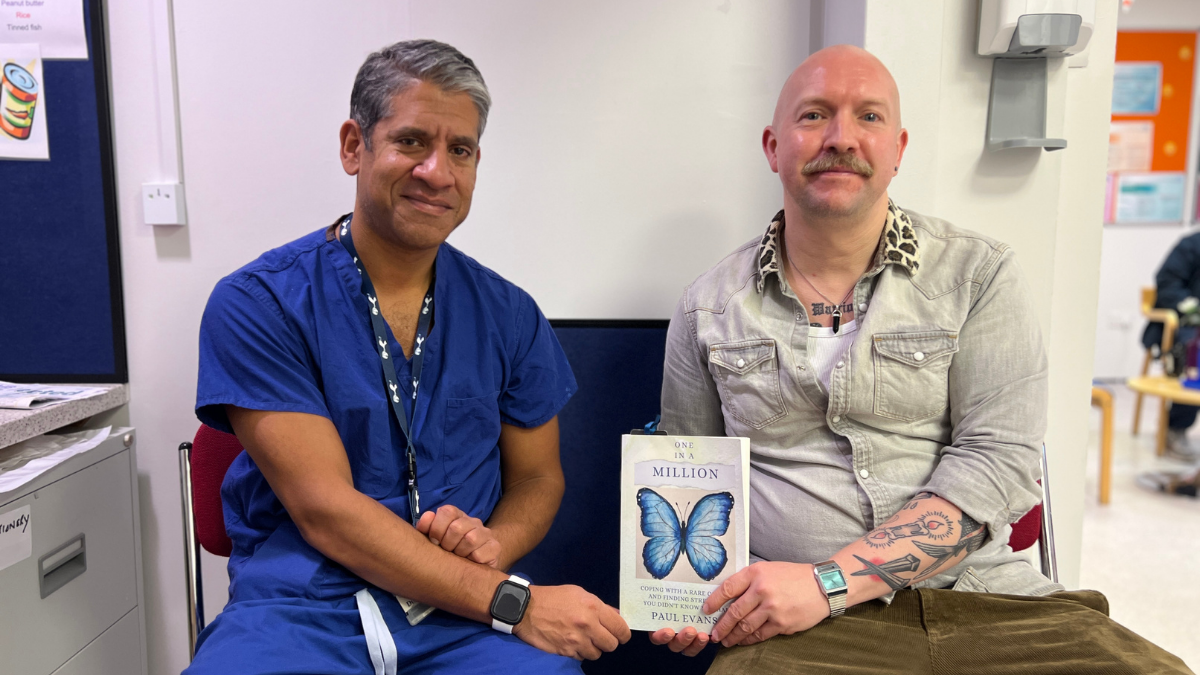
In April, Paul met with specialist Colorectal and Peritoneal Surgeon, Mr Umar Shariff, at Good Hope Hospital, which is a national centre for peritoneal cancer surgery. The proposed treatment plan was cytoreductive surgery combined with HIPEC - heated chemotherapy delivered directly into the abdomen. The operation, performed by Mr Shariff at Solihull Hospital, removed over 30 percent of his bowel and left a 14-inch scar across his stomach.
Paul said: “After the surgery, I realised no-one tells you how to live in between the scans, the treatments, the fear. So I wrote and self-published the book I wish I’d had.”
In just two weeks, Paul poured 40,000 words onto the page, reliving the most traumatic chapter of his life. The result is a raw, honest, and unexpectedly uplifting memoir that explores not just survival, but transformation.
“Cancer, ironically, has been the best thing that’s ever happened to me,” he reflects. “It made me slow down, re-evaluate who I am, and discover what really matters. The book, called One in a Million-Coping with a rare cancer and finding strength you didn't know you had, features a rare butterfly on the cover, drawn by Paul himself, as a symbol of fragility and resilience.
Paul is now cancer free and although he admits the psychological impact has been the most challenging aspect of his illness, he is embracing the next chapter of his life with a newly found focus on creativity. “There’s so much fear around cancer,” he says. “But treatments are evolving. It’s not a death sentence. There’s hope, belief, and a way through.”
Paul’s surgeon, Mr Shariff said: “I feel both proud and privileged to be mentioned in Paul’s book. Paul’s courage in sharing his story is extraordinary. The way he conveys the emotional, physical, and psychological challenges is both humbling and inspiring. His book will be invaluable to the wider surgical community and anyone facing similar adversity.
“From a clinical perspective, I am proud to say Paul’s story exemplifies the strength of collaborative care on offer by the University Hospitals Birmingham (UHB) Colorectal team. Together across our hospitals, we brought a multi-disciplinary approach, combining surgery, oncological insight, specialist cancer nursing and compassionate support.”
Have you had bowel cancer? The UHB bowel cancer support group is available to help and support you. Contact colorectalcnsghh@uhb.nhs.uk