Pioneering double lung transplant gives patient new lease of life
Published on 08/10/2026
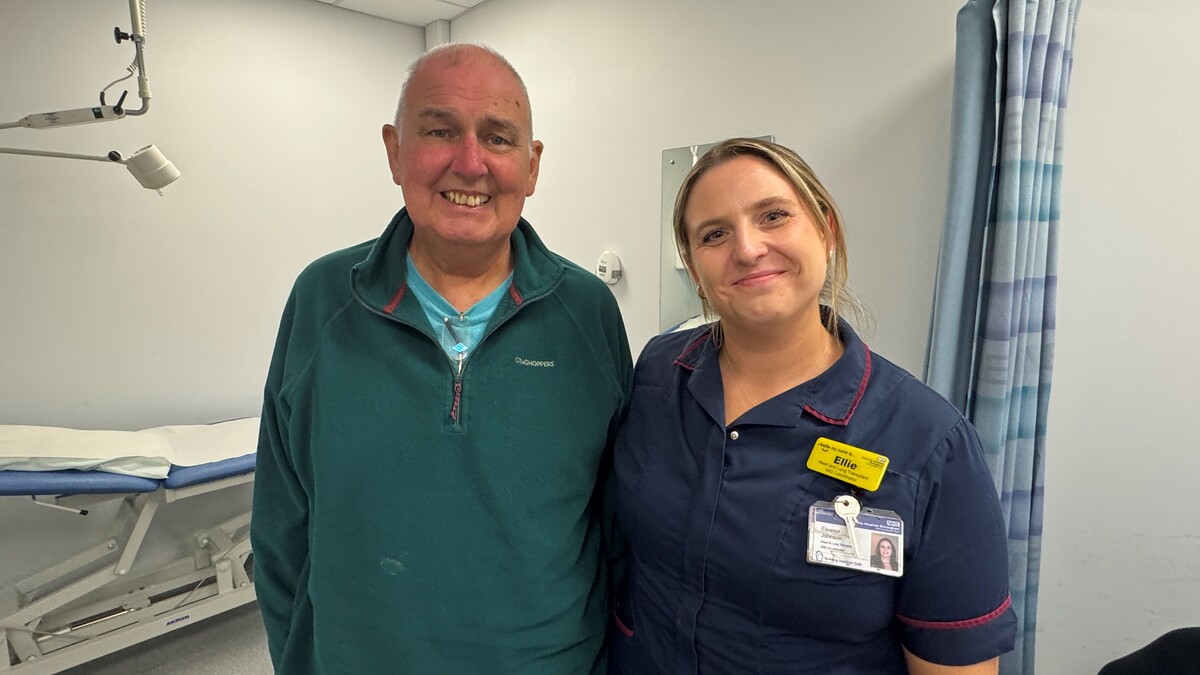
Just weeks after receiving a double lung transplant at the Queen Elizabeth Hospital Birmingham (QEHB), Joseph McConnell is walking his rescued greyhound, returning to the rugby touchline and making plans for the future.
He is sharing his story to encourage more people to register as organ donors and tell their families about their decision.
Before becoming seriously ill, 62-year-old Joseph, from Newport in South Wales, spent much of his working life as a self-employed carpenter. His career took him across the country and included work on major construction projects such as the Channel Tunnel. He later became a buildings manager at a school in Cardiff.
But as his health deteriorated, everyday life became increasingly difficult. Joseph was eventually diagnosed with idiopathic pulmonary fibrosis, a condition that causes scarring of the lungs, and was told that he needed a transplant.
By then, Joseph knew how serious his condition had become.
“I was dying,” he said. “I was grey, I was blue and I was down. Everyone who knew me could see it.”
Joseph, a father to two ‘daddy’s boys’, was referred to the lung transplant team at QEHB and following his assessments, he was placed on the transplant waiting list.
Joseph was called to the hospital seven times when potential donor lungs became available, but on each occasion the transplant could not proceed. It was the eighth call that finally changed his life.
Although the prospect of major surgery was daunting, Joseph said the support of his wife, Anita, and the hospital team helped him remain positive.
“You don’t know whether you’re going to wake up or not,” he said. “But I was surrounded by positive people and that made me feel positive.
“My wife, the nursing staff and the anaesthetists all put me at ease. There was plenty of banter and I remember thinking, ‘Come on, let’s just do it.’”
When Joseph woke after the transplant, his wife and sister came to see him. He later discovered that, despite everything he had been through, he had already started taking selfies and asking for them to be sent to friends and family.
Just 10 weeks later, Joseph described himself as “a different person”. Before the transplant, he needed an oxygen cylinder and struggled for breath. Now, he is once again able to enjoy walks with Anita and their seven-year-old rescue greyhound, Molly.
“I haven’t got to walk around with an oxygen tank anymore,” he said. “Everyone tells me how well I look. They say, ‘Look how pink you are. You’re not blue, you’re not grey and you’re not gasping for air.’
“In comparison with 10 weeks ago, I’m a different person.”
Joseph is also looking forward to returning to one of his other great passions: live rugby. A former referee, he enjoys watching both a local youth side and senior team every Saturday.
His recovery is continuing and, as Joseph readily acknowledges, there can still be difficult days. For now, his focus is on gradually rebuilding his strength and enjoying the everyday experiences that illness had taken away from him.
“It is actually giving your life back”
Joseph said the care he received throughout his transplant journey made a lasting impression on him. He recalled how staff supported him through some of his most vulnerable moments and treated him with kindness and dignity.
“The care that was given was absolutely brilliant,” he said. “It wasn’t just the surgeons or the transplant team. It was everyone. There was care and love from every single person.”
Joseph is deeply conscious that his recovery was only possible because another person chose to donate their organs, and because that person’s family supported donation at an extraordinarily difficult time.
“I’m so humbled and so absolutely grateful,” he said. “I wouldn’t be here without them. I’m now booking holidays.”
For Joseph, organ donation means simply “a new lease of life”. His experience has strengthened his own commitment to donation and made him determined to encourage others to make their wishes known.
Looking ahead to dog walks, rugby matches and holidays with his family, Joseph hopes his experience will help people understand the difference one donor can make. “It is actually giving you or someone else their life back,” he said.
We are also able to reveal that Joseph was the first patient in the country to receive a lung transplant through the UK’s pioneering Assessment and Recovery Centres pilot programme.
The programme could allow more donated organs to be used by giving specialist transplant teams additional information about how well they are functioning. Some organs fall into a clinical “grey area”, where initial checks do not give teams enough certainty to proceed. Because decisions must often be made quickly, these organs may previously have been declined.
The pilot introduces a new “three hospital” approach. An organ is donated at one hospital, taken to a specialist centre for detailed assessment using machine perfusion technology, and then transported to a third hospital for transplantation.
In Joseph’s case, the donor lungs travelled from one hospital to Royal Papworth Hospital in Cambridge. There, specialists used ex vivo lung perfusion to assess the lungs outside the body. They were then transported to Queen Elizabeth Hospital Birmingham, where the specialist transplant team successfully carried out Joseph’s double lung transplant.
The Assessment and Recovery Centres programme was developed by NHS Blood and Transplant in collaboration with the cardiothoracic transplant community and is funded by the Department of Health and Social Care. It is the first national programme of its kind in the world. If the pilot is successful, this approach could become the standard way of assessing donated organs that need further evaluation before they can be accepted for transplant.
Following a significant and concerning reduction in organ donation, it is hoped the programme is able to increase the number of transplants by around 20%, potentially saving or improving a further 750 lives every year.
Joining the NHS Organ Donor Register gives you the opportunity to record your organ donation decision. It is also important to talk to your family and loved ones so they understand and can support your wishes.
Register your decision on the NHS Blood and Transplant website