Artificial intelligence software to help clinicians save the lives of stroke patients in Birmingham
Published on 30/06/2023
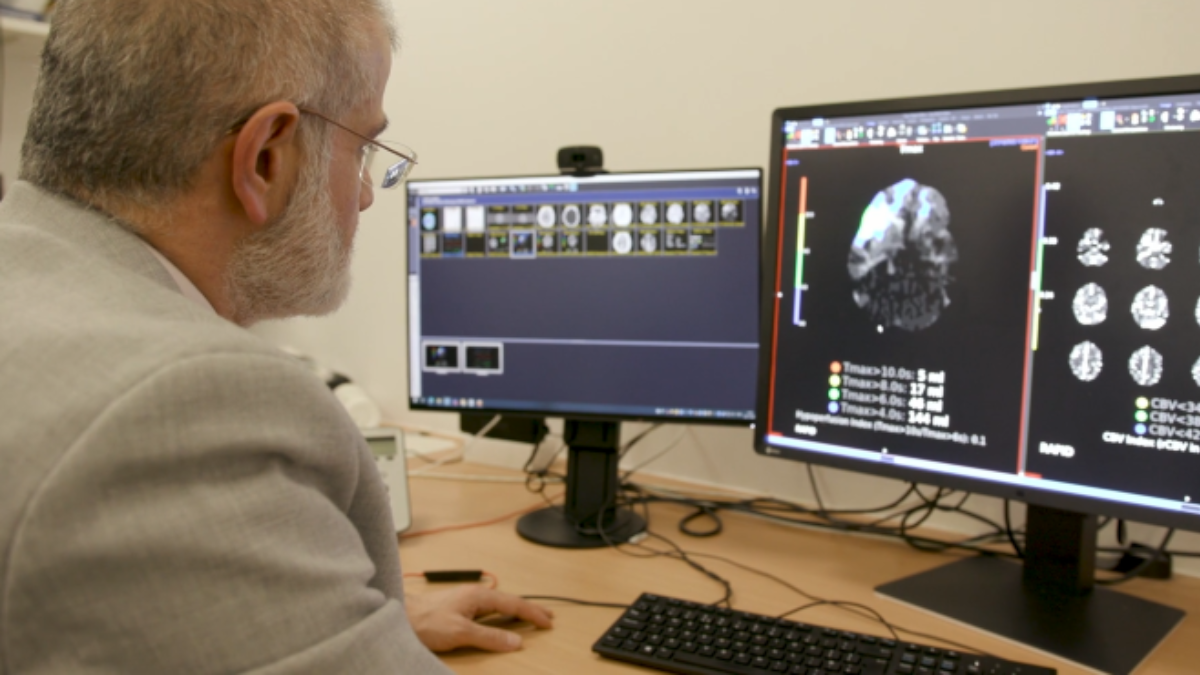
We are excited to announce that the artificial intelligence software ‘RapidAI’ was introduced at the Queen Elizabeth Hospital Birmingham last week, with the aim of improving care for stroke patients across Birmingham and further afield. Interventional neuroradiology and stroke teams, with the support of Digital Transformation and Imaging IT departments, have launched RapidAI as part of the Trust’s strategy to improve patient care through the adoption of new, cutting edge technology.
Stroke is a life-threatening and disabling condition, where the blood supply to part of the brain is cut off. Patients require rapid treatment in the form of drugs, or in cases where an artery is blocked, a revolutionary procedure called mechanical thrombectomy can be carried out by interventional neuroradiologists to remove the clot. This restores blood flow to the brain and prevents long-term harm.
Timely and effective management of patients with suspected stroke is vital to ensure the best outcome for the patient. Brain scans of patients are used to identify the cause of the stroke and the speed and accuracy in the interpretation of these scans by clinicians is critical to diagnosis and treatment.
To aid faster decision making and rapid intervention by clinical teams, artificial intelligence (AI) solutions for stroke are increasingly being adopted across the NHS. Queen Elizabeth Hospital Birmingham, part of University Hospitals Birmingham (UHB) NHS Foundation Trust, is the first hospital within the West Midlands Stroke Network to implement the artificial intelligence software, RapidAI.
The software creates enhanced, high-quality images from patient scans, to empower clinicians to make faster diagnoses and treatment decisions for stroke patients.
Dr Kurdow Nader, Consultant Neuroradiologist at UHB, said: “I am delighted that we have launched this crucial technology, which will allow us to bring the benefits of mechanical thrombectomy to more patients”.
Dr. Don Sims, Consultant Stroke Physician at UHB, added: “The clinical team still make the final decision, but the AI software allows speedy transfer of films with an initial report attached. If more patients with a stroke are then able to access thrombectomy, we know that this improves outcomes and reduces disability and dependency for patients.”
At present, the Queen Elizabeth Hospital Birmingham performs approximately 200 thrombectomies per year. The ambition is to double this number by 2025/2026, but in order to reach this target, there is a need to speed up the diagnosis and identification of patients eligible for this life-changing treatment.
Robert McEwan, Digital Transformation Lead at UHB, said: “Launching RapidAI within UHB is a really important first step in a bigger plan, which involves working with other local NHS hospitals to ensure the software is available across the region. This will allow increasing numbers of patients across the West Midlands to benefit from this technology.”