Hospital ‘first in the Midlands’ to use innovative endoscopy tech
Published on 05/05/2026
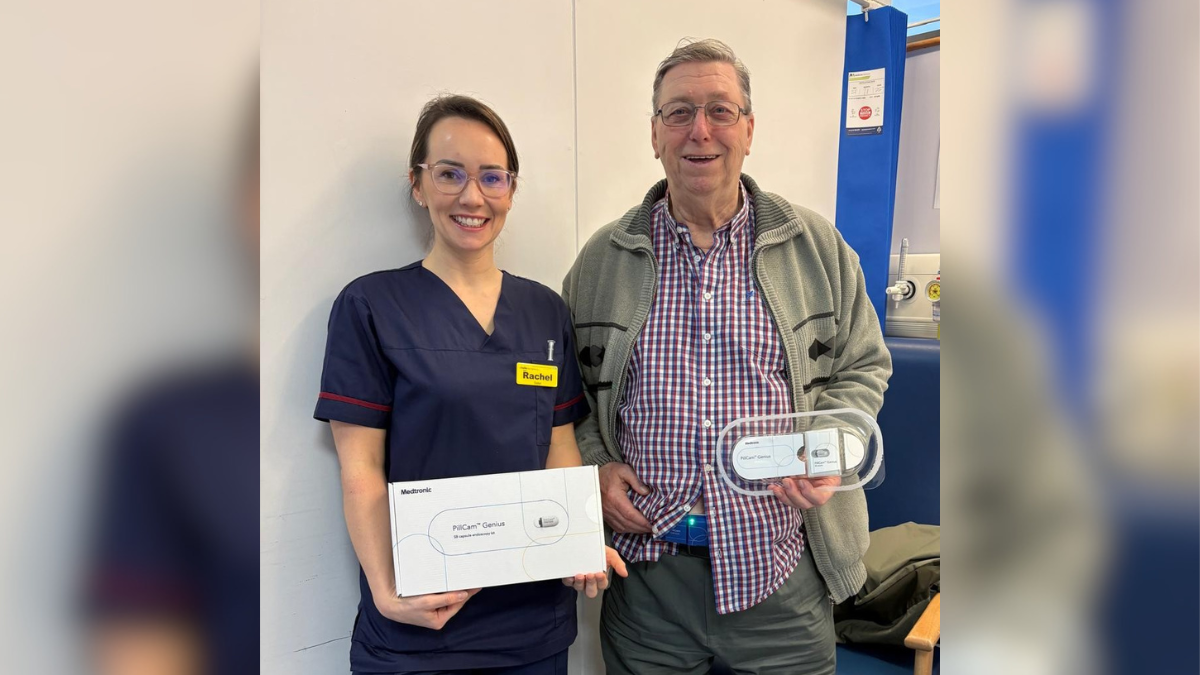
The Endoscopy team at Good Hope Hospital has begun using the latest generation of capsule endoscopy technology, a less invasive and more comfortable way to examine the small bowel.
The hospital already runs one of the region’s most established capsule endoscopy services within University Hospitals Birmingham (UHB), performing a high number of procedures each year. The service plays a key role in diagnosing conditions such as inflammatory bowel disease (IBD) and iron deficiency anaemia, where visualising the small bowel, an area traditionally difficult to reach, is essential.
Now, the team is using a new “patch-based” system called Genius, supported by medical technology company Medtronic, that replaces the traditional belt and bag equipment used to capture images of the small intestine. Good Hope Hospital is the first in the Midlands to begin using the technology.
Rachel Hilmo, Capsule Endoscopy Practitioner, who has helped lead the launch alongside Dr Mark Andrew, Consultant Gastroenterologist, and two other nurse practitioners, said: “Patients swallow a small capsule that contains a camera and light. As it travels through the small bowel, it takes thousands of pictures that help us identify conditions such as inflammatory bowel disease or the causes of iron deficiency anaemia.
“Traditionally, patients have had to wear a bulky belt and carry a crossbody bag with a small computer that receives the images. It can feel quite restrictive and uncomfortable, and some patients don’t want to go out in public while wearing it.”
The Genius system replaces this with a discreet adhesive patch placed on the abdomen, which contains all the necessary technology to receive and store the images, which is more comfortable and convenient for patients. “They can get on with their normal day-to-day activities without feeling self-conscious.”
Currently, patients return the patch to the hospital the next day so staff can download the data. However, the long-term aim is for the technology to transmit information directly to a secure cloud-based system, allowing clinicians to review results remotely and reducing the need for hospital visits.
Feedback from the initial patients, along with the clinical team’s evaluation, will help shape how the technology could be rolled out more widely across UHB’s endoscopy services. Rachel added: “Because our capsule endoscopy service is already so well established, we were selected for the limited market launch. We are proud to be part of testing new innovations that make a genuine difference to patient experience, and it feels like we are on the cusp of a big step forward in this field.
Rachel added: “It has been a whole team effort to make this happen, and I would like to particularly thank Tim from our IT Services team who was instrumental in helping us set up the technology.
“With advances in artificial intelligence and digital integration, capsule endoscopy will only become more effective and patient friendly. It’s exciting to be part of that progress.”