How to Find Audiology
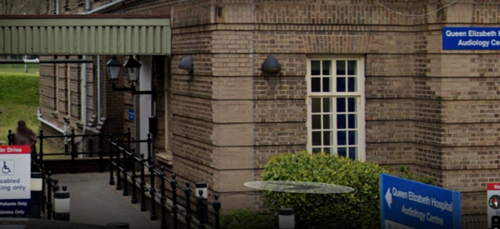
The Queen Elizabeth Hospital Audiology Centre (QEHAC) is based in Nuffield House opposite the Heritage Building. The Entrance is on the left hand side of the building.
Heads of service
- William Brassington- Head of Audiology Services (HGS and QEH)
- Jennifer Parker-George - Clinical and Operation Site Lead Audiology, QEH
- Ben Adams - Clinical Coordinator/Operational Lead Hearing Implants Audiology, QEH
- Tracey Greene - Admin Manager
If you would like to contact one of the heads of service, please use the below contact details and they will be sent to the correct person.
- audiology@uhb.nhs.uk
- 0121 371 7100
- 07939 988 871 (text SMS service)
- The Queen Elizabeth Hospital Audiology Centre
Ground floor
Nuffield House
Mindelsohn Way
Edgbaston
B15 2TH
We are a very busy department, if we are not able to answer the phone, please leave a message with your details (your name, date of birth and hospital number if possible) and we will get back to you.
Contact details
Hearing aids
- audiology@uhb.nhs.uk
- 0121 371 7100
- 07939 988 871 (text SMS service)
- The Queen Elizabeth Hospital Audiology Centre
Ground floor
Nuffield House
Mindelsohn Way
Edgbaston
Birmingham
B15 2TH
Bone Conduction Hearing Implants (BCHI)
- audiology@uhb.nhs.uk
- 0121 371 7104
- 07939 988 871 (text SMS service)
- The Queen Elizabeth Hospital Audiology Centre
Ground floor
Nuffield House
Mindelsohn Way
Edgbaston
Birmingham
B15 2TH
Cochlear and Middle ear implants
- audiology@uhb.nhs.uk
- 0121 371 7103
- 0121 371 7118
- 07939 988 871 (text SMS service)
- The Queen Elizabeth Hospital Audiology Centre
Ground floor
Nuffield House
Mindelsohn Way
Edgbaston
Birmingham
B15 2TH
If we cannot answer your call, please leave your name, date of birth and hospital number, if known, and we will get back to you. You can also email us, which is often the quickest way to contact the department.
If you only need batteries or replacement parts, let us know and we will post them to you. We will only contact you if we need more information.
The department is closed at weekends and on bank holidays and does not provide an out-of-hours service.
If you need urgent medical attention, please attend an emergency department (A&E) or urgent treatment centre.
Feedback, compliments and suggestions
If you would like to leave feedback for Audiology, please use one of the below methods:
- Give feedback
- audiology@uhb.nhs.uk
- 0121 371 7100
- 07939 988 871
- The Queen Elizabeth Hospital Audiology Centre
Ground floor
Nuffield House
Mindelsohn Way
Edgbaston
B15 2TH
How to get a hearing assessment
If you think you have a hearing loss, please speak to your GP.
Sudden hearing loss
Sudden hearing loss, or a sudden change in hearing, can have different causes, some of which may need urgent investigation and treatment.
If you experience sudden hearing loss (over three days or less), you should arrange to see your GP or attend your nearest urgent treatment centre or emergency department.
Appointment types and what happens
These are common aspects that may occur in an appointment.
Assessment or reassessment appointments
- A brief medical history
- A discussion about your hearing
- Ear examination
- Hearing tests
- A discussion of results and future steps
Fitting appointments
- Ear examination
- Hearing aid fitting
- Hearing aid instructions
- What to expect from hearing aids
Review appointments
- Ear examination
- Discussion about your experience with the hearing aids
- Addressing any issues or questions you may have
Repair appointments
- Ear examination
- Service/repair the hearing aid
These appointments are not for adjusting or fine-tuning hearing aids nor for hearing tests
Useful websites
Information relating to hearing loss
- C2Hear Online
- Royal National Institute for Deaf People
- Birmingham City Council: Sensory Impairment Services (you can self refer to this service)
- NHS: Hearing aids and Implants
- BID Services
- Access to work
- Transport for West Midlands (patients needs to have severe to profound hearing loss and proof of this to apply.)
Information relating to cochlear implants
- British Cochlear Implant Group
- National Cochlear Implant Users Association
- BID Services
- Transport for West Midlands (patients needs to have severe to profound hearing loss and proof of this to apply.
- Access to work
- Sense
- Birmingham City Council: Sensory Impairment Services (you can self refer to this service)
Information relating to assistive listening devices
- Connevans (funded by yourself)
- Birmingham City Council: Sensory Impairment Services (you can self refer to this service)
Information relating to tinnitus
- Royal National Institute for Deaf People
- Tinnitus UK
- Tinnitus Kit
- Hearing aid mobile app: Resound Smart
Information relating to balance
- Menieres Society
- Vestibular Migraine
- The Migraine Trust
- Vestibular
- Neurosymptoms
- Fitness Studio - NHS
Hearing aid apps
Information relating to bone conducting hearing implants (BCHI)
Advanced diagnostic hearing tests
We are able to undertake advanced diagnostic hearing tests within the department.
These tests are used for a variety of reasons, the main one being for people who cannot complete a hearing test. These tests do not require a response so do not need someone to press a button to say they have heard a sound, These tests can also provide valuable information that cannot be gained from a routine hearing test.
There are several types of advanced tests we perform.
Otoacoustic Emissions (OAE)
A simple and quick test. A soft tip is placed in your ear and some sounds are played, this tells us how well the hearing organ is working. This tests takes a few minutes to complete.
Cortical Evoked Response Audiometry (CERA)
The appointment is 2 hours long. It involves recording the signals in your auditory cortex (the part of the brain that deals with sound) that have been generated due to a sound you have heard. We can detect these signals by placing electrodes on your scalp and behind your ears. The signals are then recorded and analysed, this information can tell us a persons hearing level, and the status of the auditory cortex pathway from the ear to the cortex. For this test you need to be alert so if you do have one please bring something quiet that will keep your brain active.
Auditory Brainstem Response (ABR)
The appointment for this will be about 1 hour. This test involves recording the signals in your brainstem that are generated in response to sound. We can record and measure these signals by placing electrodes on the scalp and behind your ears. Unlike CERA you need to be nice and relaxed for this test. The information gained from this test is not available through a routine hearing test.
Auditory Steady State Response (ASSR)
Home visits
A referral from your GP is needed for a home visit. If you are not in our area, we will forward your referral to your local centre.
For home visits, you will be informed of the appointment date, but we are not able to give a precise time.
Last reviewed: 28 October 2026